
Why the 432 Hz, 7 Hz, and “listen for 60 seconds and you’re new again” videos cannot do what they claim and why the real signal, if you generate it at home, is not a toy.
I am not here to talk about secret standards or a hidden hand that retunes your music in a basement. I am talking about devices, codecs, speakers, and titles. About what actually survives after you press upload. About what your phone can play. And about what happens when you stop watching other people’s thumbnails and generate the tones yourself.
Tens of thousands of people sit in the same loop I sat in. A video says 432 Hz. Another says 7 Hz, 10 Hz, 28 Hz, 396, 528, 963. Comments under it sound like a church. You download the file. You run an analyzer. You get the same boring standard as everything else. You start to suspect the whole niche is a costume.
You are not crazy. The costume is the product.
Two numbers people keep mixing up
Before anything else, the vocabulary is a mess. Social media treats every number as if it were the same kind of thing.
Concert pitch is a tuning reference. In modern music, A4 is usually 440 Hz. The 432 Hz story is just that same note placed a little lower about thirty-two cents, less than a third of a semitone. That is a musical choice. It is not a sample rate.
Sample rate is how many times per second the file is measured. Compact discs are 44.1 kHz. Video platforms like 48 kHz. People see 44.1 and say “the standard is 4400.” No. One number is a note. The other is a grid. Platforms do not “convert your healing track to 4400 Hz.” They re-encode audio into a format they can stream.
If you do not separate those two, every analysis looks like a conspiracy. It is not. It is a pipeline.
What a platform actually does to your file
YouTube, TikTok, Instagram, Facebook do not scan a track, detect “this was tuned to 432,” and shove it back to 440. That is not a feature. They do not care.
They resample. They compress with AAC or Opus. They normalize loudness YouTube aims near minus fourteen LUFS. On cheaper streams they shave the top end. On a lot of phones the playback becomes almost mono. That is the whole trick.
Resampling is not a pitch shift. If a note was truly at 432 Hz in a clean file, a correct resample does not drag it to 440. What it does is cheaper and uglier: it throws away precision, smears a thin sine into a blob, and sometimes deletes the part of the spectrum your title was bragging about.
I learned this the only way that counts. I built a tone generator. I wrote frequencies I chose. I analyzed the local file. The peaks were where I put them. Then I uploaded the same audio to the usual platforms, downloaded what the world actually receives, and ran the same analysis again.
The second file was not the first file. Different peaks. Missing lows. Energy sprayed into places I never wrote. Some extra tones I had layered in were simply gone. Not hidden. Gone.
That is not a spiritual correction. That is a codec doing its job.
The 7 Hz problem, and why your ears never get the number
Human hearing, in a good room with a good life behind it, lives roughly between 20 Hz and 20 kHz. Seven, ten, twenty-eight those sit under or on the edge. You do not hear them as a note. If anything, you feel them as pressure, and only if a real subwoofer, real volume, and a room that can hold the wave are in the chain.
A phone speaker does not hold that wave. Cheap earbuds do not. A laptop does not. Most living-room bars do not. And before the speaker even tries, the platform has already high-passed or starved the bottom of the file. So the clip titled “7 Hz healing” is not putting 7 Hz into your head. It is putting a label into your feed.
Binaural beats are a different animal and still fragile
Sometimes the 7 Hz is not a 7 Hz sine sitting in the file at all. It is a trick of two tones: 200 Hz in the left ear, 207 in the right. The difference is supposed to be built in the brain, not in the waveform. That only works with stereo headphones and separated channels.
Play it on a phone speaker and the trick dies. Downmix to mono and it dies. Compress it badly and the carriers get dirty. Plenty of videos never built the carriers correctly in the first place. They just wrote “theta” on the thumbnail and laid ambient pads underneath.
396, 432, 963 audible, and still not a miracle
These are not infrasound. A sine at 432 or 963 can survive an upload in the crude sense that the fundamental is still somewhere in the audible band. The platform does not owe you a retune to 440. That part of the street myth is wrong.
What does not survive is the claim. DNA repair. Fear leaving the body in sixty seconds. Crown chakra online. The file can contain a pitch. It cannot contain a sacrament.
After compression the “exact” frequency is often not exact anyway. Pitch-shifted 440 tracks sold as 432 wander. Analyzers read 430 one second and 434 the next. Most “432 Hz” music on the big sites was never generated at 432. It was a normal record pulled down by software, or it was never pulled down at all. The title did the work.
I listen to ambient music. Some of it is good for the ears. It can slow you down. That is music, habit, expectation, a quiet room. It has nothing to do with the divine as the networks sell it. “Play this tone for sixty seconds and you are new again” is a sentence that dies the moment the file leaves the author’s machine.
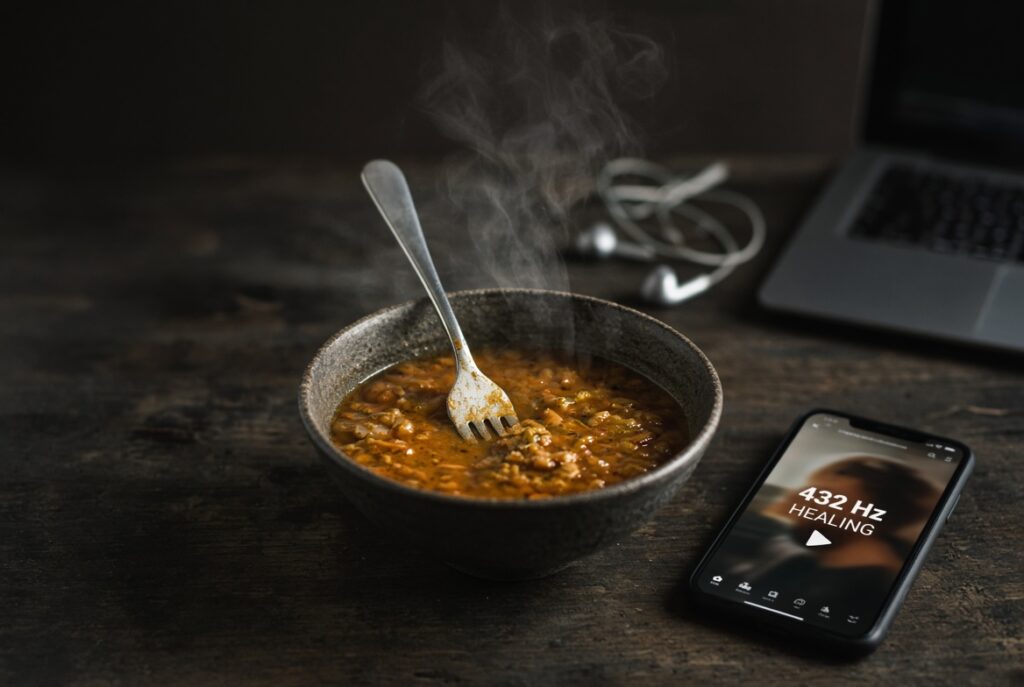
The fork and the soup
Imagine someone tells you this soup will heal you. Then they hand you a fork.
The soup, if it exists at all, is a clean signal on a local machine, measured, played back on a system that can actually reproduce those values. The fork is the platform: bitrate, resampling, a two-inch speaker, autoplay between two ads.
You cannot eat the soup with the fork. That is not a plot. That is cutlery.
People get angry when you say this because the thumbnail promised a spoon. The comments promised a spoon. The creator may even believe they uploaded a spoon. Then you measure the file the audience receives and you are holding steel tines.
What I did at home and why I deleted the files
A local generator is another world. On your own computer the tone is what you wrote. No codec has eaten it yet. That is the only place the numbers in those titles can even exist as advertised.
It is also the place where the story stops being funny.
I was playing. I lined up four different files, four different frequencies. Two seconds of delay between each. When the fourth one started, my vision went. Not a blur. Gone. I shut the laptop completely and stepped away from it. About two minutes later the picture came back.
I deleted the files after that. I went to a doctor. The eyes were fine. The sentence I brought home was that the problem was neurological.
I am not going to reconstruct those four files for anyone. I am not going to list the frequencies as a recipe. One tone, loud and stupid, can already be aggressive next to your head. A stack of pure tones is not “more healing.” It is interference, beating, pressure, a shove the nervous system did not ask for.
The platform clip cannot give you the miracle. The local stack can still give you an incident. Those two facts live together.
If something like that happens to you, it is not proof that 528 Hz opens the sky. It is proof that sound is physical. Eyes checked out, nervous system flagged. That is a clinic sentence, not a comments-section sentence. Do not repeat the experiment to see if you can make it happen twice.
Why the niche feels like a large fake
Because it sells the number, not the signal.
The upload path will not carry 7 Hz to a phone. It will not preserve a laboratory sine. It will not deliver a sixty-second reset. It will deliver a mood, if the music is good, and a caption.
Creators who actually pitch-shift a track still hand the result to a meat grinder. Creators who only write the number in the title skip even that. Listeners who feel better were going to feel something from slow music and a dark room anyway. That feeling is real as a feeling. It is not a measurement of 432.
I do not need a villain in a suit for this to be true. The market made a genre out of a unit. Hertz became branding.
The part that is not fake
Sound is not imaginary. Volume is not imaginary. A clean tone on a capable system is not imaginary. If you generate locally, you can measure what you made. If you upload, you can measure what remains. The difference between those two analyses is the whole article.
Ambient music can be kind to the ears. Use it as music. Do not ask it to be medicine with a serial number.
A generator on your own machine is a tool. Tools are not moral. Information is not moral. The person who does not know the limits hearing range, speakers, codecs, volume, stacking can take a tool and walk it into harm. That does not make the information evil. It makes the user responsible.
On the public web, the promise is technically empty. On the desk in front of you, the signal can be real, and that is exactly why you treat it like something with weight, not like a challenge video.
If you want a test that does not wreck you
Do not hunt miracles. Hunt files.
Generate a single audible tone at modest level. Analyze it. Upload it. Download it. Analyze it again. Look at the peak, not the sample rate. That is the experiment that ends the argument.
For the fashion numbers under 20 Hz, assume the phone never had them. For binaural claims, assume anything that is not headphones in stereo never had them. For 396 and 432 and 963, assume the pitch can exist and the theology cannot.
And leave stacked pure tones alone unless you are in a lab that knows what it is doing. I already paid that bill.
What I am actually saying
Everything you see in that niche on social media is, as a technical delivery system, fake. Not because a secret committee retuned the planet. Because the pipe cannot carry the object they named.
Music of rest can still be good. It will not be divine on a timer.
On your own computer you can make the object. That is a different sentence. Make it, if you must, with the respect you would give anything that already once took your sight for two minutes and sent you to a doctor who pointed at the nervous system instead of the eyes.
They told you the soup would heal you. Then they gave you a fork. Some people will keep chewing metal and calling it lunch. Measure the bowl. Then decide.
Note to readers
This is not medical advice and not a protocol. If sound ever blanks your vision, stop the source, get distance, and talk to a clinician. Do not stack tones to “see what happens.” The public clips cannot keep their promises. Your speakers and your brain still can surprise you and not as a blessing.